

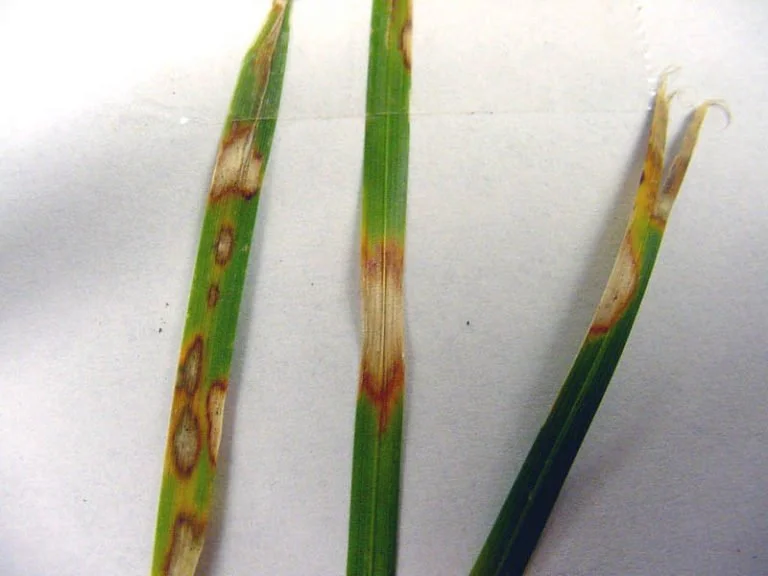
Brown Patch Fungus on a grass leaf blade
When it rains every day fungus will weaken your lawn.
Fungus occurs when three things happen.
The pathogen is present (spoiler, it’s always there)
It has a host to feed off of (spoiler- your grass is the host)
The conditions are ripe for it’s progression.
What conditions does fungus like? Wet. With summer rains there is no stopping fungus from proliferating.
What do you do? Lets go through some options.
Do Nothing?
It’s an option. I don’t think it’s a great one, but fungus like grey leaf spot isn’t going to kill a healthy, well fertilized lawn entirely. It can stress it. But adding stressors is not what we’re trying to do. Things that stress warm season grasses are; mowing, drought (or water restrictions), traffic, herbicides, cold (not applicable from March-Nov in Florida). And if your lawn isn’t in perfect form then why add fungus to the stressors? There are some fungi like fairy ring, left untreated, can wipe out large sections of your lawn! So this approach isn’t reliable.
Reduce Watering/Removing Water
This WILL help because the fungus needs the moisture to grow. But, so does your grass! You can’t eliminate all water from your lawn. You can improve drainage to make sure water doesn’t pool and that low areas dry out. Those are typically the places a lawn will get fungus first. Solutions for low spots include french drains, grading the area, even some leveling with sand. BUT you can’t control the rain. If it rains every single day right before it gets dark, you can’t control that.
Your lawn needs 0.5in of water 2 times per week (St Augustine).This allows the water to penetrate deep into the soil to promote root growth and strengthen your lawn. 0.1in every late afternoon won’t penetrate deep enough before evaporating so you do still need some irrigation most of the time. Using a sprinkler timer with a working rain sensor can help you reduce watering when it does rain enough to meet those requirements! Smart timers can also use weather date from NWS to reduce the watering.
Bonus Tip: Keep in mind, if your St Augustine or Zoysia grass blades are folding up, they need more water. You can fix this immediately for the short term with a quick hit of the hose or sprinkler, but you may need to water longer on your normal watering days for that zone to make sure the water penetrates deeper (and also your grass roots).
Stop the Pathogen
Fungus comes in many types, grey leaf spot, brown patch, fairy ring, and others. But the one thing they have in common is that they all start with a pathogen that just exists everywhere. You can’t stop it from getting on your lawn. But you can stop it from proliferating. Using a fungicide BEFORE fungus is a problem will help you avoid the problem in the first place, and cost you less money. That’s because a curative rate of fungicide is way more expensive than a preventative application.
For a home owner buying Scotts DiseaseEx- a 10lb bag costs about $22 where the label suggests 2lbs/ 1,000 sqft per application for preventative and 4lbs per 1,000 for curative, suggesting that it “may" be reapplied at 14-28 day intervals. That means, your preventative cost for a 5,000 sqft lawn is $44 and the curative cost is $88.
One of our favorite fungicides is Armada 50 WDG. The preventative rate of application to prevent leaf spot is 0.6oz per 1,000 sqft of turf. It also requires 2 applications 14 days apart for a total of 1.2oz of fungicide. The curative rate is 1.2-1.5 oz per 1,000sqft and also requires 2 applications 21—28 days apart. One bottle of this professional grade fungicide costs about $150 for 32 oz so those costs add up quickly.
Group Numbers?
There are many different fungicides out there and they all have very scientific sounding names like Azoxystrobin or 1,3-Dioxolan-2-one,4-methyl (yes, that’s one chemical). Fungus can build resistance to fungicides that use the same “mode of action”. Simply, the mode of action is what process in the plant (bug, or fungus) is the chemical interrupting, inhibiting, or altering. You don’t need to know how these all work to figure out how to build a fungicide plan that prevents resistance, uses less chemicals, and fits into an Integrated Pest Management (IPM) program.
Just looks for the group numbers! On every bag or bottle of fungicide you use, there will be a little box with the word “Group” and 1 or 2 numbers. If you go through a full application of one fungicide (2 applications), and you still have a problem, try a chemical with a different group number. I use Armada 50 WDG because it already contains chemical that are in 2 different groups so I don’t have to use as much fungicide, and if a frustrated home owner wants me to solve their fungus issue we don’t have to guess at the group number they already applied and waste time.
Call the Professionals
All of this is very possible for a DIY homeowner to do. Some simple math, a scale, and a spreader or sprayer will get the job done. But if you don’t want to brave the summer heat and want you lawn to be as strong as possible to avoid weeds, bugs, and fungus, hit the “Get a quote” button at the bottom of the page.